2.2.2What do limits have to do with continuity?

Intuitive Ideas of Continuity

2-57.

Examine the graph of y=f(x) at right. Evaluate:

  1. limxf(x)

  2. limxf(x)

  3. limx4f(x)

  4. limx2f(x)

  5. One of the limit statements above determines the horizontal asymptote of f. Which one? Explain.  

  6. Sketch a graph of y=arctan(x). Describe the end behavior of the graph by writing two limit statements, one for each of its horizontal asymptotes.  
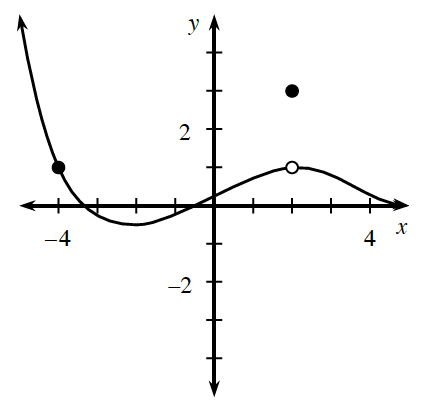
Curve coming from upper left, turning at the approximate point (negative 2, comma negative 1 half), & at the exact open point (2, comma 1), continuing down & right at the x axis, with highlighted open point on the curve at (negative 4, comma 1), & discrete point at (2, comma 3).

2-58.

On your graphing calculator, graph f(x)=1x2.

  1. Describe what happens to f as x approaches 0 on each side? (i.e. Evaluatelimx0f(x) and limx0+f(x).)

  2. Do both sides (the left-hand and right-hand limits) agree?  

  3. What is limx0f(x)?

2-59.

For each function below, explain why the limit does not exist at x=2.

  1. Piecewise, left ray, starting at open point (2, comma 2), passing through the origin & going down & left, right ray, starting at closed point (2, comma 3), passing through the point (3, comma 2), continuing down & right.

  1. Dashed vertical line at, x = 2, decreasing curves, one on each side of vertical line, left curve opening down, coming from left below x axis, passing through the point (0, comma negative 1 half, continuing to negative infinity, right curve, opening up, coming from infinity, continuing down & right, above x axis.

2-60.

Sketch f(x)=|x|x. Evaluate limx0f(x) or explain why it does not exist.

2-61.

Now let’s look at the relationship between limits and continuity. Examine the graph at right and use it to complete the table below.

If a limit does not exist, enter “DNE” into your table.

a

limxaf(x)

limxa+f(x)

limxaf(x)

f(a)

1

2

3

4

Your teacher will provide you with a model.

2-62.

Look at your results from problem 2-61 and consider the relationship between limits and continuity by analyzing the following conditions. Justify each response with sketches that show examples and/or counterexamples.

  1. Is a function continuous at x=a if limxaf(x) does not exist?

  2. Is a function continuous at x=a if f(a) does not exist?   

  3. Is a function continuous if both limxaf(x) and f(a) exist?

  4. Use your answers from parts (a) through (c) to explain when a function is continuous at a point.

2-63.

Given the graph at right, determine the following values.

  1. limxf(x)

  1. limxf(x)

  1. f(2)

  1. limx2f(x)

  1. f(0)

  1. limx0f(x)

  1. f(3)

  1. limx3f(x)

  1. Is the function continuous at x=0? Explain. 

Your teacher will provide you with a model.

Review and Preview problems below

2-64.

Kimberly is always complaining that it is either too hot or too cold. As a matter of fact, she is so picky that she is only happy when it is exactly 72F. At 8:00 a.m. it is 65F. By 3:00 p.m. it is 90F. Homework Help ✎

  1. Is there a time when Kimberly is happy?

  2. If at 6:00 p.m. the temp is 70F, what is the minimum number of times Kimberly was happy today?

2-65.

A mug of hot coffee is poured and then set on the counter. Homework Help ✎

  1. Sketch a feasible graph showing the temperature of the coffee as a function of time. Do not worry about units, just show the general behavior of the graph.

  2. Evaluate the following limit and translate the entire limit statement into a complete sentence.
    limx( temperature )=

2-66.

Using set notation, state the domain and range for each of the functions below. Homework Help ✎

  1. Upward V, vertex at the point (1, comma 1), passing through the point (0, comma 2).

  1. Increasing curve, opening down, starting at the point (negative  3, comma negative 2), passing through the y axis between 1 & 2, continuing up & right.

2-67.

Sketch one function that satisfies all of the following conditions. Does your graph have any asymptotes? Homework Help ✎

  • limxf(x)=2

  • limx3f(x)=4

  • limx3+f(x)=1

  • limxf(x)=2

2-68.

If you plot the finite differences of a parabola, the result will be what type of function? Homework Help ✎

2-69.

Using sigma notation, write a Riemann sum to estimate the area under the function f(x)=xcos(x) for 2x6 with eight left endpoint rectangles of equal width. Then use the summation feature of your graphing calculator to calculate the estimated area. Homework Help ✎

Continuous curve, coming from lower left, turning at the following approximate points, down at, (negative 3.5, comma 3), up at (negative 1, comma negative 1 half), down at (1, comma 1 half), up at (4.5, comma negative 3), continuing up & right, with 7 visible shaded vertical bars, each of width 1, starting at x = negative 2, placed between the curve & x axis, with a left vertex of each bar, on the curve.


2-70.

Alter your sigma notation from problem 2-69 to estimate the area with 16 rectangles and use it to approximate the area. Were your results the same? Homework Help ✎

2-71.

If f(x)=x3x+5, evaluate: Homework Help ✎

  1. limxf(x)

  1. limxf(x)

  1. limx5f(x)

  1. f(x5)

  1. f(2m+3)

  1. f(x+h)

  1. For parts (a) and (b), explain the graphical significance of limxf(x) and limxf(x).

2-72.

THE CLUNKER

Tiffani has an old car that she is constantly repairing. One day, she is driving to school when she starts having problems with the car’s fuel injection system. Her velocity (in feet per second) is shown at right. Homework Help ✎

  1. Recall that acceleration is the rate of change of velocity. How is acceleration represented on a velocity graph?

  2. When is her acceleration negative?

  3. What is her maximum acceleration?

  4. Describe the motion of the vehicle when the acceleration is zero.

  5. How far does Tiffani travel during the 12 seconds shown in the graph?

First quadrant, x axis labeled time, seconds, y axis labeled velocity, feet per second, with Continuous linear piecewise, starting at (0, comma 40), running right then turning down at (2, comma 40), turnight right at (4, comma 20), turning up at (5, comma 20), turning right at (6, comma 60), turning down at (8, comma 60), turning right at (10, comma 40), stopping at (12, comma 40).